
BPC 157 Research Current Evidence Questions and Laboratory Standards

BPC-157 has become a prominent search topic as interest grows in preclinical tissue and gastrointestinal research. Much of the online discussion, however, blends laboratory findings, clinical data, personal testimonials, and sales claims. A useful research guide must separate those evidence levels. BPC-157 is a synthetic 15-amino-acid peptide discussed in preclinical research. Most frequently cited findings come from cell or animal models, and strong human clinical evidence remains limited. This article explains what the compound is, why researchers study it, how to evaluate the evidence, and which quality controls help produce interpretable results.
What researchers mean by BPC-157
Laboratory discussions often focus on angiogenesis, nitric-oxide signalling, inflammatory mediators, and cellular responses involved in tissue organization. These proposed pathways are hypotheses under study, not proof that the peptide treats injuries or digestive conditions in people.
Peptide names also require precision. A sequence modification, salt form, conjugate, terminal change, or formulation can alter molecular mass, stability, receptor activity, and analytical behaviour. Researchers should record the complete chemical description rather than using a nickname alone. If two publications study different variants, their results may answer different questions even when the articles use similar shorthand.
Why BPC-157 is receiving attention
Search interest in BPC-157 reflects a mix of scientific reporting and consumer curiosity. The most useful way to assess that attention is to return to the original evidence. Check whether a result comes from a biochemical assay, cultured cells, an animal model, an observational report, or a controlled human trial. Then look at sample size, comparator, duration, dose range, prespecified endpoint, and adverse-event reporting. A statistically significant laboratory result may be valuable without demonstrating a practical human outcome.
Researchers should also distinguish a plausible mechanism from a demonstrated effect. Receptor binding or pathway activation can justify further experiments, but it does not establish safety, clinical efficacy, an appropriate dose, or long-term consequences. Reviews and news reports can help locate a study, yet the methods and full data are the proper basis for interpretation.
Research questions worth investigating
- What evidence comes from animal models?
- Which proposed pathways need human confirmation?
- How can researchers avoid overstating recovery claims?
- What analytical records support reproducibility?
These questions can be narrowed into measurable hypotheses. A study might compare a concentration-response curve, measure a defined signalling marker at several time points, or test stability under controlled storage conditions. Narrow questions usually produce more useful evidence than broad experiments designed to confirm a popular claim.
Quality testing and material verification
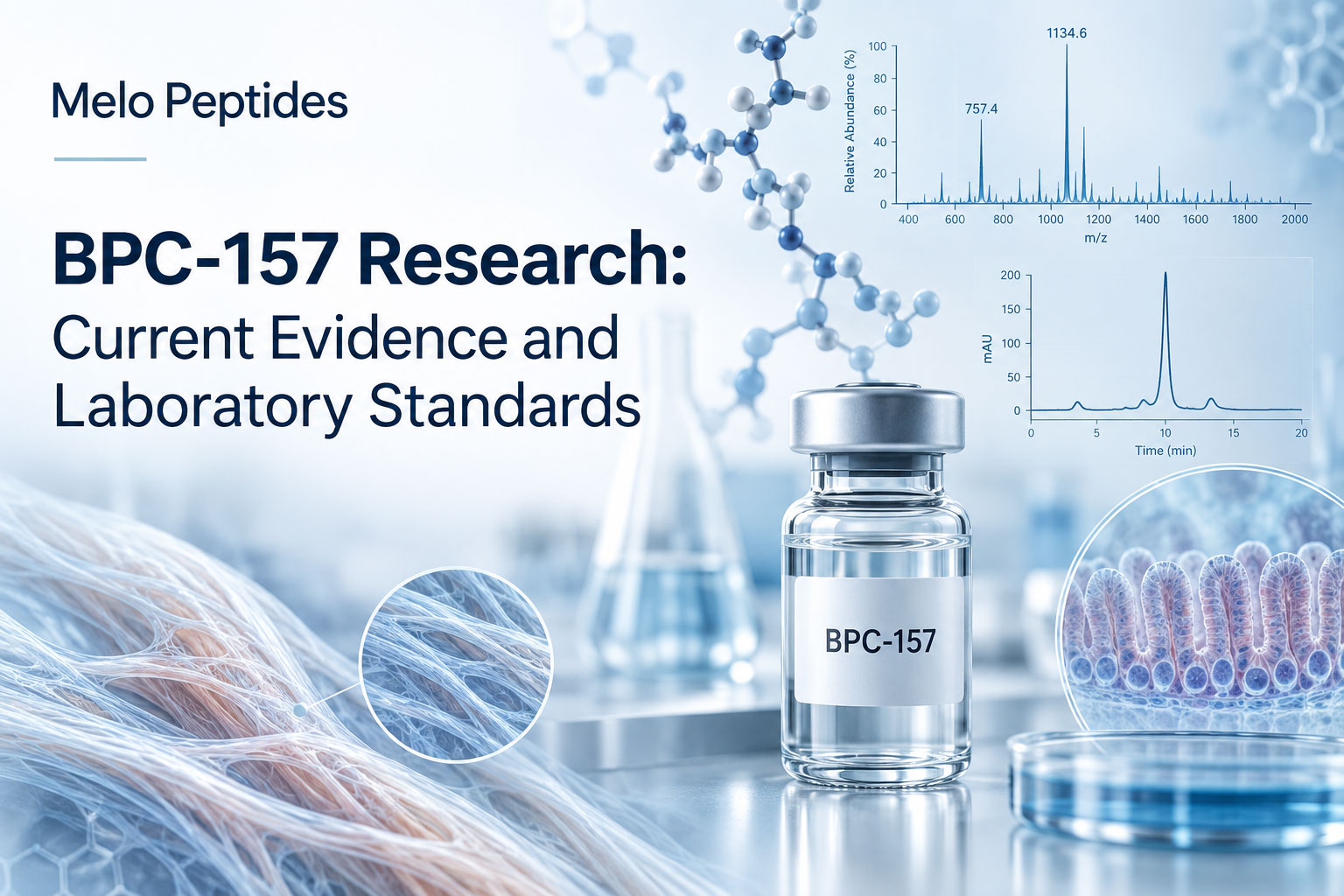
Peptide research is sensitive to material identity. A label can name the intended compound, but it cannot prove that the vial contains the correct sequence at the stated amount. A useful quality file connects the lot number to analytical evidence. High-performance liquid chromatography can estimate chromatographic purity, while mass spectrometry can support molecular identity. Neither method alone answers every quality question. Water content, counterions, residual solvents, bioburden, endotoxin, aggregation, and fill-weight accuracy may matter depending on the experiment. Researchers should decide which attributes are critical before a study begins.
A certificate of analysis should be read as a technical record, not a decorative badge. Confirm that the compound name, lot number, test date, method, result, and responsible laboratory align with the supplied material. A purity percentage without a chromatogram or method context has limited value. Independent testing may add confidence, but only when the sample chain of custody and method are documented.
Designing a reproducible study
A defensible protocol starts with a specific hypothesis. It identifies the biological model, vehicle, concentration range, exposure period, positive and negative controls, primary endpoint, and statistical plan. Replicates should be biological when possible rather than repeated readings of one sample. The protocol should also record preparation time, storage temperature, freeze-thaw events, and any visible change in the material. These details often explain variation that would otherwise be attributed to the peptide.
For BPC-157, the protocol should reflect the proposed mechanism rather than copy a concentration from an unrelated model. Solubility and adsorption losses should be assessed during method development. Vehicle controls help identify effects caused by pH, solvent, preservatives, or handling. When several peptides are combined, single-compound arms are needed to determine whether an observed response comes from one material or an interaction.
How to discuss the evidence responsibly
Responsible content states what was studied and avoids turning a preliminary result into a treatment promise. Use phrases such as “investigated in cell models” or “evaluated in a controlled trial” when they accurately describe the source. Avoid guaranteed outcomes, dosing directions, before-and-after promises, or language that encourages unsupervised use. Regulatory status and intended use should be visible, especially when a search term overlaps with a prescription medicine.
What Melo Peptides emphasizes
Melo Peptides supports laboratory planning by emphasizing clear product identity, batch-level documentation, transparent analytical information, and research-use-only labelling. Buyers should review the documentation for the exact lot they intend to study and confirm that the available specifications match their protocol. Product information should support a research decision; it should never be interpreted as medical guidance or permission for personal use.
BPC-157 frequently asked questions
What does BPC stand for?
The abbreviation is commonly expanded as body protection compound.
Is BPC-157 supported by human trials?
Human evidence is sparse compared with the volume of online claims. Preclinical findings should not be presented as established clinical outcomes.
Why is BPC-157 called a recovery peptide?
The label comes largely from animal studies and online marketing. It is not a substitute for an approved indication.
What tests can support identity?
Laboratories commonly use mass spectrometry for identity and chromatographic methods to evaluate purity.
Is research-use-only the same as pharmaceutical grade?
No. The phrases describe different intended uses and quality frameworks and should never be treated as interchangeable.
Final perspective
BPC-157 is a meaningful research topic because it raises testable questions about preclinical tissue and gastrointestinal research. Its popularity does not remove the need for careful evidence review. Researchers can improve the value of their work by verifying the exact material, choosing controls that match the mechanism, documenting handling conditions, and reporting limitations alongside results. Melo Peptides provides research-use-only materials for qualified laboratory work and encourages customers to evaluate current literature, regulatory requirements, and lot-specific analytical records before ordering.
Research-use notice For laboratory research only. Not for human or veterinary use. This article provides general scientific information and is not medical advice.